

How It Works
HyperFlow Perps is an aggregation layer on top of Hyperliquid. Understanding the model explains both where the fee savings come from and what safeguards protect your funds.
The model in one picture
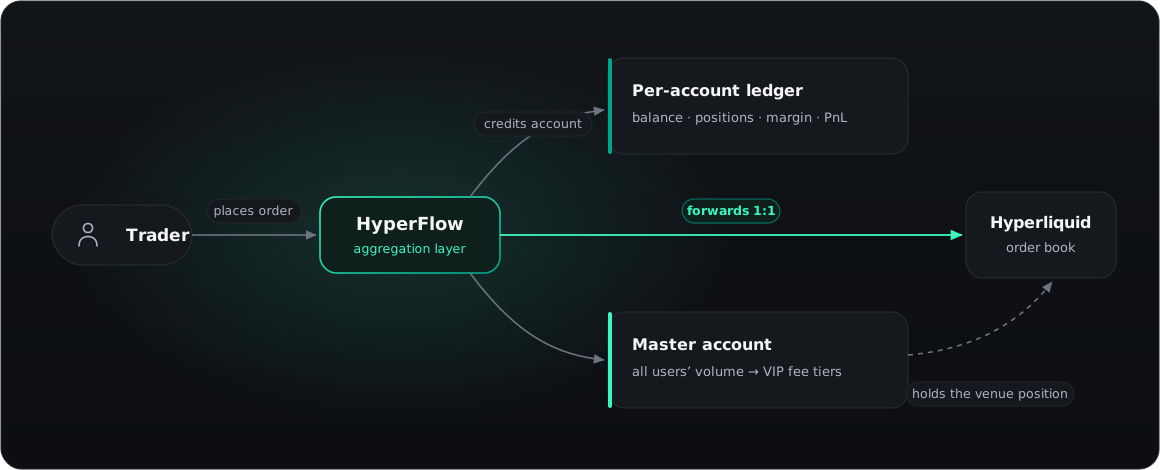
- You place an order on HyperFlow — market, limit, or stop.
- HyperFlow forwards it to Hyperliquid through its master account — the single pooled Hyperliquid account that holds all users’ positions. Market orders are sent as marketable IOC orders; limit orders rest on the real book. There is no internal matching engine and no synthetic pricing: every fill is a Hyperliquid fill.
- Your account is credited on HyperFlow’s ledger — your balance, position, margin, funding, and PnL are tracked per account, on top of the master account.
Why this makes trading cheaper
Hyperliquid prices its fees on two dimensions, both measured per account:
- Rolling 14-day volume tiers — higher volume, lower fees.
- HYPE staking discounts — up to 40% off for the largest staking tiers.
An individual retail trader almost never reaches the top tiers. HyperFlow’s master account aggregates the volume of all its traders and the platform’s staked HYPE, so it sits in fee tiers that are structurally out of reach for individuals — and the savings versus the standard retail rate are shared with you on every trade. The exact mechanics and current numbers are on Fees & Save on Fees.
What stays on Hyperliquid
HyperFlow deliberately does not reinvent the venue. Sourced directly from Hyperliquid:
HyperFlow adds the aggregation layer: per-account accounting, fee optimization, risk management, and the trading interface.
The custody trade-off, stated plainly
Pooling volume is what unlocks the fee tiers — and it requires pooling custody. When you deposit, your USDC is held in HyperFlow’s custody and credited to your account on the platform ledger; positions are carried by the master account on Hyperliquid.
This is the same structural model as a brokerage, and we treat the responsibility that comes with it as a first-class product requirement:
- On-chain proof: per-wallet balances and open positions are continuously mirrored to the public HyperflowProof contract on HyperEVM, so anyone can verify the ledger against what the platform reports. See Transparency & Security.
- Multi-signature withdrawals: every withdrawal is approved by a quorum of independent signers before it leaves custody — no single key can move user funds.
- Insurance Fund: a dedicated fund absorbs liquidation shortfalls so one trader’s bankruptcy never becomes another trader’s loss. See Liquidations & Insurance Fund.
- Scoped trading keys: trading is authorized by a short-lived trading key (valid 7 days) that you can revoke at any time — your wallet’s main key never touches order flow.
Spot swaps and bridging on HyperFlow are separate products and remain fully self-custodial — they execute from your own wallet. The pooled model applies to perps trading.
Where the model goes next
- Order batching & netting. Long and short flow arriving in the same short window can be netted before hedging, so only the net position change reaches the venue — cutting venue fees further without changing your fill experience. (Distinct from today’s batch submission, which sends up to 20 individually-signed orders in one request without netting them.)
- Cross-venue routing. The same aggregation model extends to routing across multiple perp venues, choosing the best execution (fees, depth, funding) per hedge.
Both layers compound with today’s rate optimization rather than replacing it.
Next: Orders & Margin